

What if you could meet mountain gorillas without building your holiday around a long safari? Gorilla trekking without a long safari is possible when you keep the itinerary focused on the trek and choose a guided format that fits your available time.
A shorter trip can raise practical questions: Will the schedule feel rushed? What can you fit around the trek? The key is to simplify the journey, not the gorilla encounter. Extra safari activities can stretch a short break, while a focused itinerary keeps the trek at the center and gives travel the attention it needs.
This guide compares day, two-day, and three-day Uganda gorilla trekking options. A day experience is the most compact choice, a two-day tour keeps the trip focused, and three days gives the itinerary more breathing room. You’ll also find guidance on choosing private, family, or group tours to suit your travel plans. Compare the formats against your available days and preferred pace, whether you have a brief window or can set aside more time for the forest.
Key Takeaways
- Plan gorilla trekking without a long safari by centering your trip on one guided trek rather than fitting in several safari activities.
- Compare day, two-day, and three-day formats against your available travel days and preferred pace.
- Make room for the trek and the travel around it instead of assuming both will fit neatly into any arrival-and-departure window.
- Plan transport as part of the itinerary so the journey supports the trek rather than making a short trip feel rushed.
- Choose a guided tour format that suits your plans, whether you’re travelling privately, with family, or in a group.
Gorilla trekking without a long safari: what a short trip can realistically include
A short gorilla trip is a focused itinerary built around one guided trek, not a fast-moving circuit through several parks. Instead of combining gorilla trekking with multiple wildlife stops, you give the forest encounter priority and keep the surrounding plans simple. This can suit travelers with limited vacation days who want to see Uganda’s mountain gorillas without committing to a longer safari.
Short doesn’t mean instantaneous. Your itinerary still needs to account for travel to and from the trekking area, necessary arrangements, and the trek itself. Those elements shape the schedule, so the number of days alone doesn’t tell the whole story. The Uganda Wildlife Authority manages Uganda’s national parks and wildlife. Read more in this overview of its role.
What does a short gorilla trekking trip mean?
A focused trip reduces the number of activities around the trek, not the care given to planning it. A longer wildlife circuit may include several destinations and different safari experiences. A shorter format keeps the gorilla trek at its center, with travel and other necessary arrangements fitted around it. The practical length depends on travel logistics and the tour format you choose, so itineraries won’t all have identical timings or inclusions.
Can you see gorillas without adding a long safari?
Yes. You can prioritize gorilla trekking without adding multiple safari stops. A shorter itinerary can’t guarantee a sighting or determine how long the trek will take, though. Keep the plan flexible enough to give the guided trek its proper place rather than treating it as a fixed-duration activity squeezed between transfers.
A focused gorilla trip simplifies the journey around one guided trek; it doesn’t rush the trek itself.
That distinction helps you decide what to leave out. You might skip extra park visits and use your available days to reach the trekking area, take part in the guided walk, and continue your journey afterward. This can make gorilla trekking without a long safari more manageable while keeping the main experience central.
Think of the trip as connected parts, not a trek with optional travel attached. Arrival arrangements, transport, the guided trek, and onward travel all affect how much time you need. Before adding another activity, consider whether it fits without putting pressure on those essential parts. A focused itinerary can still be rich in forest sights and sounds, while leaving room for the practical journey as well as the encounter.
Start with the days you can genuinely set aside, then match them to a tour format. Day, two-day, and three-day guided options give you different ways to center a trip on gorilla trekking. Choose according to the time available and the pace you prefer, not on the assumption that a shorter schedule guarantees a shorter trek or a particular outcome.
What cannot be rushed on a short gorilla trekking itinerary
A short itinerary works best when its sequence is clear: arrive and complete the necessary arrangements, take part in the guided trek, then continue onward or depart. Each part depends on the others. If you schedule departure too close to the trek, a change in timing can put pressure on the whole plan. The aim isn’t to fill every available hour, but to give the essential steps enough space.
A shorter trip doesn’t have to mean a rushed encounter. Keep the trip focused without compressing the guided trek. If time is limited, leave out extra safari stops and plan travel around the trek instead of treating it as a brief activity between transfers.
Why the trek day needs breathing room
The guided trek is the central activity, and its timing can vary. The walk may take longer or less time than you expect, so avoid placing a tightly timed onward journey immediately afterward. Use the itinerary’s operational guidance to plan the trek day rather than assuming it follows a fixed schedule.
Give yourself room to follow the day’s pace. That buffer helps the trip feel considered, not hurried.
Which logistics shape the shortest practical plan?
Transport, permit arrangements, and the order of travel days all shape the schedule. Plan them together: align the permit date with the journey, allow time to reach the trekking area, and schedule onward travel after the trek with enough flexibility. Transfer times and permit steps depend on the selected itinerary and current arrangements. For official information, consult the Uganda Wildlife Authority official website.
On a short wildlife trip, a travel buffer protects the day that matters most.
Use this planning order to see whether your available days can support the trip:
- Set your travel window. Count the days for arrival, the trek, and onward travel, not just the day you hope to be in the forest.
- Place the trek within that window. Arrange the permit date and guided trek as the itinerary’s anchor.
- Coordinate transport around it. Map the journey to the trekking area and your departure so neither depends on a rushed connection.
- Then consider extras. Add another activity only if it fits without squeezing the core sequence.
For gorilla trekking without a long safari, the shortest sensible plan is the one that connects these steps cleanly. A day, two-day, or three-day guided format may suit different schedules, but the label alone can’t tell you whether the timing fits your arrival and departure. Compare the complete itinerary rather than assuming the trek can be placed into any open slot.
If you’re weighing a focused trip against a longer route, explore the guided Uganda gorilla trekking options and compare the formats with the time you have.
Day, two-day, or three-day gorilla trekking: compare short trip formats
The right format depends on how much time you can set aside and how much flexibility you want around the trek. A day experience is the most compressed option. Two and three days create more space in the itinerary, but transport and the details of your travel window still matter. No format can guarantee a gorilla sighting or a particular trek duration.
| Itinerary length | Best fit | Pace | Planning considerations |
|---|---|---|---|
| Day | Travelers prioritizing a focused trek with minimal additional activities | Most compressed | Feasibility depends on transport, permit arrangements, and current itinerary logistics. |
| Two days | Travelers who want a focused trip with more room around the trek | Compact, with added flexibility | Coordinate travel and trek arrangements across the available days. |
| Three days | Travelers who can allow more time for the journey and itinerary | Less compressed than a day trip | Use the additional time thoughtfully; don’t assume it includes activities beyond those specified in the itinerary. |
When might a day gorilla trekking experience suit you?
A day experience may suit travelers with a narrow window who want to focus on gorilla trekking rather than add multiple safari stops. It’s still a guided trek that requires travel and permit arrangements, so the short label doesn’t remove those planning steps. Before choosing this format, consider whether the transport sequence and itinerary logistics work with your arrival and departure plans.
How do two-day and three-day options differ?
The extra time in a two-day or three-day plan can give the overall itinerary more flexibility, without changing the need to plan around the trek. Bwindi Mountain Gorilla Trekking Tours offers a two-day Uganda gorilla trekking tour and a three-day mountain gorilla trekking experience. The best fit depends on your available days and preferred pace, rather than a universal rule that longer is always better.
Choose the day format if your priority is a tightly focused trip and the logistics fit. Consider two days if you want a little more room in the sequence, or three if you can devote more time to the journey. In every case, compare the full itinerary rather than relying on duration alone. For wider context on gorilla conservation, the Dian Fossey Gorilla Fund International shares information about its protection, research, and education work.
For a practical next step, explore guided gorilla tour options and compare the formats with the time you have available.
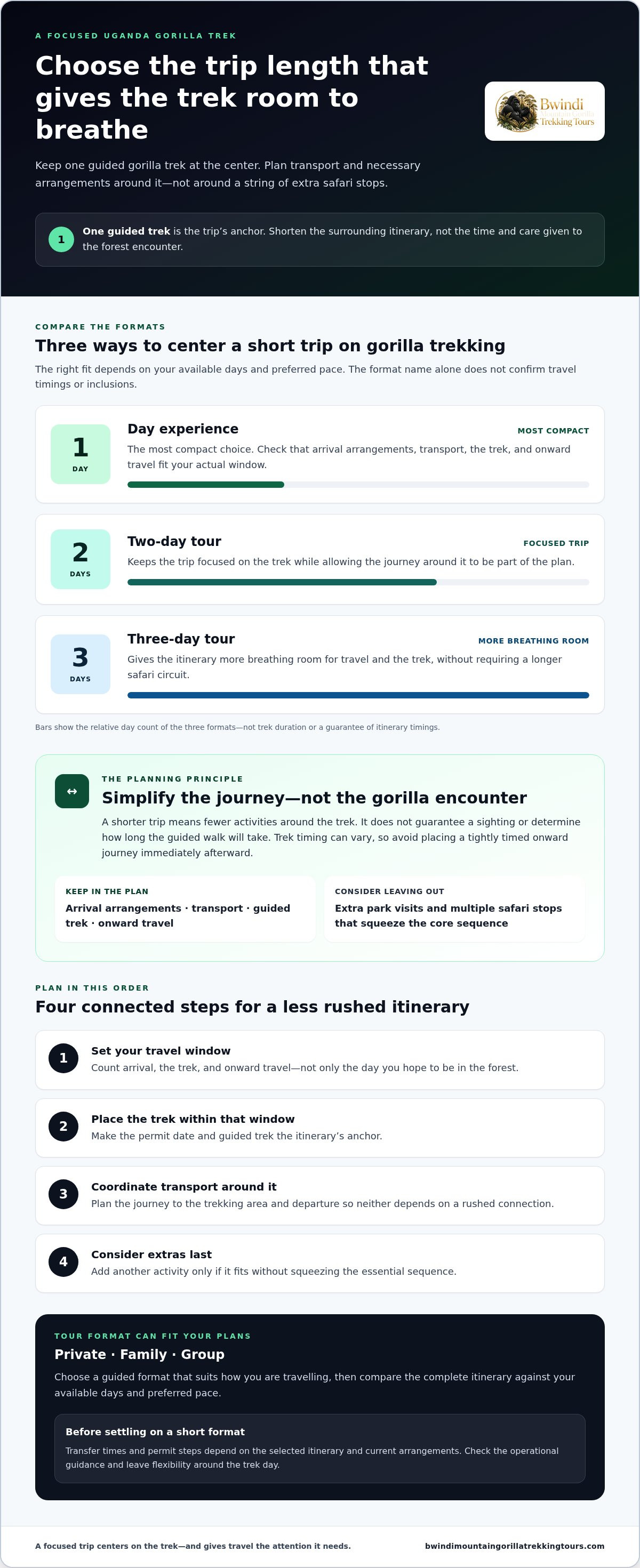
How to plan a short gorilla trekking trip without a rushed itinerary
Start with the days you can actually travel, then build the plan around the guided trek. This keeps the main experience in view before optional safari activities compete for limited time. A short trip isn’t simply a longer itinerary with days removed. It needs a clear sequence, with transport and trek arrangements considered together from the start.
A practical sequence for building your itinerary
Use this order to shape a focused plan. It can reveal early whether your travel window is too tight, before you commit to extra activities.
- Set your available travel days. Include arrival, the trek, and onward travel or departure in your count.
- Choose a guided trek format. Compare the day, two-day, and three-day options against your time and preferred pace.
- Arrange trek and transport details together. Consider how you’ll reach the trekking area and how the trek date fits the wider journey.
- Review current arrangements. Check permit requirements, schedules, and transfer information for your itinerary before finalizing your plans.
- Review optional activities last. Add another experience only if it fits without squeezing the essential travel and trek plans.
This sequence matters because a trek date affects the surrounding travel days. Treating transport as a separate problem can leave you with an itinerary that looks open on paper but has little room to adapt. For gorilla trekking without a long safari, keep the plan centered on the trek, then decide whether another activity genuinely fits the time you have.
Essential arrangements
- Travel days for arrival, the guided trek, and onward travel
- Permit arrangements and the trek schedule
- Transport coordinated with the trek date
Discretionary additions
- Extra safari activities or additional stops
- Other experiences that could make the route longer
- Plans that leave little room around transfers or the trek
How much flexibility should a short trip allow?
Leave breathing room around connections and avoid stacking activities back to back. A buffer gives the itinerary more space if plans take longer than expected, though it can’t guarantee against delays. If every transfer and activity must happen at an exact moment for the trip to work, reconsider the sequence or remove an optional stop.
Think of flexibility as protection against schedule pressure, not wasted holiday time. A quieter gap around the trek can make the overall journey feel more deliberate, while a crowded itinerary may leave little room to respond to changing timings. For a fuller planning framework, use a guide to crafting a gorilla trekking itinerary as you fit the trek and transport into your available days.
Ready to shape your travel window around a guided trek? Explore guided Uganda gorilla trekking options and compare the formats that suit your schedule.
Choose a guided Uganda gorilla trek that fits your available time
A short gorilla trip still needs a thoughtful match between your travel window and the guided trek format. The goal isn’t to choose the fewest days at any cost. Select an itinerary that gives the trek a central place while keeping the surrounding travel manageable. Bwindi Mountain Gorilla Trekking Tours offers day, two-day, and three-day guided options for travelers planning a focused Uganda visit.
Match the guided tour length to your travel window
Use your actual travel days as the starting point. A day gorilla trekking experience is the most compact option and may suit travelers focused on the trek with little time for other activities. The two-day Uganda gorilla trekking tour offers a different trip length, while the three-day mountain gorilla trekking experience gives you a longer window for the itinerary. Each depends on its own arrangements and schedule.
As you compare the formats, think about more than the number of days. Consider how much time you can devote to travel around the trek and whether you prefer a tightly focused plan or more room in the overall itinerary. The format alone doesn’t determine trek duration or guarantee a gorilla sighting. Choose the length that fits your travel window without assuming every itinerary has the same timing or inclusions.
- Consider the day experience if you have a narrow window and want to prioritize the guided trek.
- Compare the two-day tour if that duration fits your schedule and you want a short, focused trip.
- Look at the three-day experience if you can set aside a longer window for your gorilla trekking itinerary.
Private, family, and group tours offer different ways to travel. These formats can help you consider who is joining the trip and the kind of experience you want to share. They don’t replace the need to choose a suitable tour length or plan the trek around your travel days.
Take the next step toward a focused gorilla trip
Before deciding, lay out your available travel days and compare them with each tour duration. Keep the guided trek at the heart of the plan, then consider whether the necessary travel arrangements fit comfortably around it. This makes it easier to focus on gorilla trekking without a long safari while keeping expectations grounded in the itinerary, not assumptions about a particular encounter.
Guided trekking is the central experience across these options. Your guide leads the journey into the forest, while your chosen format shapes how the trek fits into the wider trip. You don’t need to add multiple safari activities to make a short visit meaningful. A focused plan can give your time and attention to the forest without promising exactly what you’ll encounter there.
Compare the three durations with your real travel window, then choose the format that feels practical for your plans. Explore Uganda gorilla trekking tours and find a guided option suited to the time you have.
Make room for the encounter you came for
A short trip can still feel complete when you travel with a clear purpose. Rather than measuring its value by how many stops you fit in, let the forest set the rhythm. The quiet of the trail, the sounds around you, and the guidance of your trekking team can make one carefully planned experience memorable in its own right.
As you shape your dates, think about what would help you feel present: a manageable travel pace, time to prepare, and an itinerary that doesn’t turn every moment into a connection to catch. That’s the heart of gorilla trekking without a long safari. You’re choosing focus, not settling for less.
When you’re ready to turn that idea into a trip, compare guided options with the time you can set aside. A thoughtful plan can bring the forest within reach, even when your holiday is brief.
Explore guided Uganda gorilla trekking tours and begin planning a journey that feels right for you.
Frequently Asked Questions
Can I go gorilla trekking without booking a long safari?
Yes, you can plan a focused trip around gorilla trekking without adding a long safari circuit. Make the guided trek the reason for the journey and limit other activities. If you have only a few days, prioritize the trek and the travel needed to reach it rather than trying to visit several parks. A focused trip still needs careful planning.
Is a one-day gorilla trekking trip possible in Uganda?
Yes, a Day Gorilla Trekking Experience is one of the guided options offered in Uganda. Whether a day format works for your plans depends on transport and itinerary logistics, not just the date you want to trek. Consider where you’ll be before and after the trek, and don’t assume “one day” means no preparation or travel arrangements are needed.
How many days do I need for a short Uganda gorilla trekking trip?
There isn’t one day count that suits every traveler. Guided options include a day experience, a two-day tour, and a three-day experience, so compare each with your available travel days and the journey involved. If your schedule is tight, map arrival, trekking, and onward travel before choosing. Your total trip length depends on the itinerary and transport logistics, not only the time spent on the trek.
Do I need to book a gorilla trekking permit for a short trip?
Yes, a permit is required for gorilla trekking, whether your trip is short or longer. Make permit arrangements for your intended trek date as part of planning, rather than leaving them until after you’ve settled the surrounding activities. Permit requirements and booking arrangements can change, so use current official guidance. A shorter itinerary doesn’t remove the need to organize the permit.
Is a gorilla sighting guaranteed during a trek?
No, a sighting can’t be guaranteed. Mountain gorillas live in a natural forest environment, and wildlife encounters are not certain outcomes. Choose a trip because you value the guided experience in the forest, not because you expect a specific result. This keeps expectations grounded and lets you appreciate the landscape and the trek itself, whatever the day brings.
What happens if the trek takes longer than expected on a short itinerary?
Trek duration can vary, so avoid scheduling a departure or another fixed activity immediately afterward. Leave room in your plan for the day to unfold without relying on an exact finish time. For example, don’t make a tight onward connection the only way your itinerary works. A flexible schedule can ease pressure, although it can’t prevent delays or guarantee a particular finish time.
Can first-time safari travelers choose a short gorilla trekking tour?
Yes, first-time safari travelers can choose a short guided gorilla trip. A guide leads the trekking experience, while choosing a day, two-day, or three-day format helps you shape the wider trip around your schedule. Before deciding, think through the journey, permit arrangements, and how much time you want around the trek. You don’t need previous safari experience to begin planning a focused visit.
